

Blooket Blook Rarity Tiers Explained: Common to Legendary
Table of Contents
- Introduction to Blook Rarity
- How the Rarity System Works
- Common Blooks
- Uncommon Blooks
- Rare Blooks
- Epic Blooks
- Legendary Blooks
- Blook Rarity Comparison Table
- Drop Rates by Tier
- How Rarity Affects Value and Trading
- Tips for Getting Rarer Blooks
- Conclusion
- FAQs
Introduction to Blook Rarity
Blooket blends quiz based learning with genuine game mechanics. Players answer questions, earn tokens, and spend those tokens opening themed boxes filled with characters called blooks.
Not every blook is equally easy to get. Blooket sorts characters into rarity tiers, ranging from Common up to Legendary, with some boxes adding extra tiers above that. This creates a real sense of progression, similar to trading cards or loot based mobile games.
Each tier has its own colored label shown under the blook`s name. This makes it easy to spot how special a pull actually is the moment you open a box.
Knowing how this system works helps you decide which boxes are worth your tokens. It also explains why certain blooks carry more bragging rights among classmates and online communities.
How the Rarity System Works
Every box opening in Blooket runs on a weighted randomization system. When you open a box, the game rolls against a hidden probability table to decide which blook you get.
Blooket has never published the exact percentages. This has pushed the community to track thousands of box openings and share estimated odds through spreadsheets and guides.
The pattern is simple even without official numbers. Lower tiers take up most of the probability pool, so Common and Uncommon results are by far the most frequent outcome.
As you climb toward Rare, Epic, and especially Legendary, the odds shrink fast. Some boxes also include pity mechanics that guarantee a better pull after enough openings, though this is not consistent across every box.
Rarity is also tied to the specific box, not the whole game. A Legendary blook in one box might not even exist in another, since each themed release has its own roster spread across its own tiers.
Common Blooks
Common blooks form the base of the entire system. Many of them are not even pulled from boxes since every account starts with a default set automatically.
These starting Commons are all animal designs. Think dogs, cats, sheep, owls, parrots, snakes, gorillas, penguins, sea otters, and walruses.
Inside themed boxes, Common blooks still appear, but they make up the biggest share of the probability pool by far. Most box openings will land here.
Because they are free and abundant, Common blooks usually cannot be sold back for tokens. There is no real economic reason to trade something everyone already owns.
They are still fully playable, though. A Common blook works exactly the same as a Legendary one in every game mode. The difference is purely cosmetic.
Uncommon Blooks
Uncommon blooks are the first tier that actually requires opening a box. They are not handed out for free like Commons.
Each themed box has its own Uncommon roster. A Medieval box might include an Elf, Witch, Wizard, Fairy, or Slime Monster, while a Wonderland box might include the Two of Spades, Eat Me, Drink Me, Alice, or Queen of Hearts.
These blooks appear less often than Commons but still fairly regularly. Most players will see several Uncommon pulls within their first handful of box openings.
Uncommons can usually be sold back for a small amount of tokens, often cited around five dollars worth of in game currency. This gives players a way to fund future box purchases.
That small trade value adds a layer of strategy. Do you keep every Uncommon for your collection, or sell duplicates to chase something rarer?
Rare Blooks
Rare blooks are where pulling something new starts to feel genuinely satisfying. The drop rate is noticeably lower than Common and Uncommon.
Players often need to open a fair number of boxes before landing a Rare blook. Because of that, a Rare pull is usually worth mentioning to friends or an online community.
Design wise, Rare blooks tend to lean further into a box`s theme than Uncommons do. The artwork usually feels more detailed and distinct.
Each box has its own separate set of Rare characters. If you want a specific Rare blook, you need to target the correct box rather than opening boxes at random.
Many experienced players recommend focusing token spending on one box at a time once you start chasing Rares. Spreading purchases across many boxes slows progress toward any single goal.
Epic Blooks
Epic blooks mark a clear jump in scarcity. By this point, most players have already collected several Commons, some Uncommons, and hopefully a Rare or two.
The drop rate here is considerably lower. Community estimates consistently place Epic as one of the harder tiers to reach without real time or token investment.
Epic blooks are often some of the most creative designs in a box. They act as a bridge between the moderately rare Rare tier and the top tier Legendary characters.
Because of their strong artwork, Epic blooks frequently become fan favorites, even when they are not the absolute rarest option available in that box.
Players often chase a specific box purely because of a desirable Epic character, not just because they are hoping for a Legendary pull.
Legendary Blooks
Legendary blooks sit at the top of the traditional rarity spectrum. They represent the ultimate prize in most themed boxes.
The drop rate is dramatically lower than every tier beneath it. Community tracking suggests many dedicated players can open large numbers of boxes without seeing a single Legendary.
Beyond rarity, Legendary blooks are usually the most visually striking characters in their box. Designers seem to reserve their best concepts for this tier specifically.
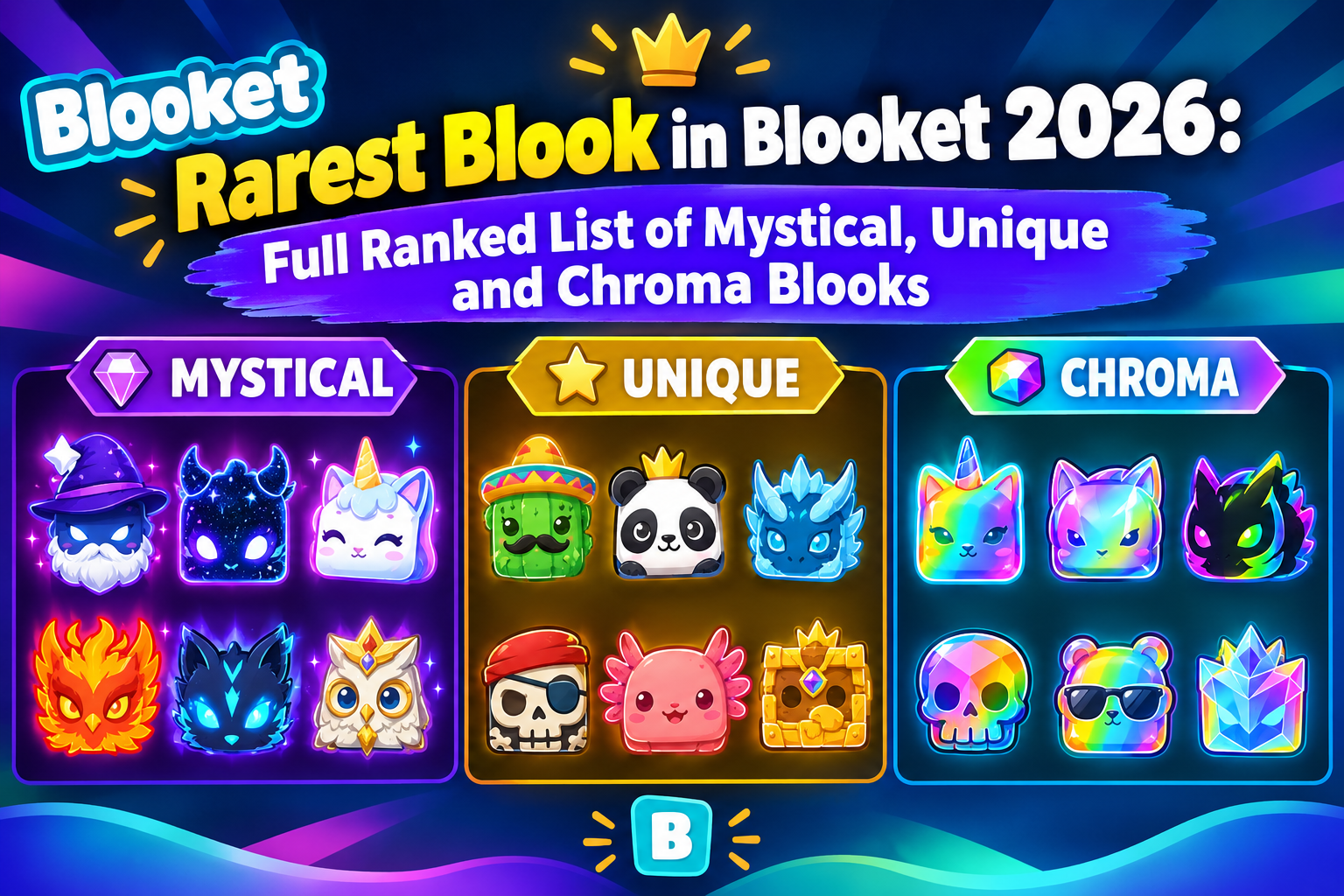
Some newer boxes add tiers above Legendary, such as Mythical or Chroma. In those boxes, Legendary becomes a milestone on the way up rather than the absolute ceiling.
Regardless of extra tiers, Legendary blooks remain the clearest symbol of dedication and luck in Blooket. Pulling one is usually a genuinely exciting moment.
Blook Rarity Comparison Table
| Tier | Relative Drop Rate | How It`s Obtained | Sellable for Tokens |
|---|---|---|---|
| Common | Very high | Given by default or common box pulls | No |
| Uncommon | High | Box openings | Yes, small amount |
| Rare | Moderate | Box openings | Yes |
| Epic | Low | Box openings, requires persistence | Yes |
| Legendary | Very low | Box openings, rare event | Yes, highest value |
| Mythical / Chroma (select boxes) | Extremely low | Specific newer boxes only | Yes, when applicable |
This table is based on community observation rather than official Blooket data, since exact percentages have never been published.
Drop Rates by Tier
Since Blooket keeps its exact odds private, most of what players know comes from crowd sourced data. Thousands of logged box openings get aggregated into shared estimates.
The overall pattern is a steep drop off as rarity increases. Common blooks often make up around half or more of a box`s total pulls, depending on the box.
Uncommon and Rare follow with progressively smaller shares. Epic blooks are usually estimated in the low single digit percentage range.
Legendary blooks are often estimated at a fraction of a percent. That is what makes them feel like true jackpot moments rather than expected outcomes.
These estimates can shift over time. Blooket occasionally updates box compositions or introduces limited time boxes with different odds tied to seasonal events.
Because of that, always check for a recently updated community guide rather than relying on older data that may no longer reflect the current box.
How Rarity Affects Value and Trading
Rarity shapes more than how a blook looks. It also affects how a blook is perceived socially and, to a smaller degree, economically inside the game.
Blooket does not currently offer a full player to player trading system. Value is expressed informally instead, through classroom conversations, online communities, and the limited built in sell option.
Lower tier blooks, especially Uncommons, can be sold for a small token return. This gives players an easy way to turn extras into tokens for future boxes.
As rarity increases, sell back value tends to rise too. But the real appeal of high tier blooks is rarely about tokens. It is about scarcity and reputation.
Owning several Legendary blooks often earns a player recognition within their classroom or online group. That social status functions as its own kind of currency.
Blooket has hinted at the possibility of expanding trading features in the future. For now, most of the value conversation stays reputational rather than transactional.
Tips for Getting Rarer Blooks
There is no guaranteed shortcut to rare blooks, but a few strategies can improve your odds over time.
Focus on one box. Spending tokens across many different boxes spreads your luck thin. Committing to a single box until you get what you want is usually faster.
Follow community data. Estimated drop rates from active trackers can help you pick boxes with comparatively better odds for the tier you are chasing.
Watch for limited time boxes. Seasonal or event boxes sometimes carry different probability structures or exclusive characters not found in the regular rotation.
Sell off duplicates. Selling unwanted Uncommon blooks helps fund more box openings without needing outside purchases.
Stay patient. Top tier pulls are intentionally rare by design. Treating collecting as a long term goal makes the process more enjoyable, especially for younger players.
Conclusion
Blooket`s rarity system, running from Common up through Legendary and sometimes beyond, is a big part of why the platform keeps players engaged past a single class period.
By pairing real probability differences with distinct character art, Blooket turns a quiz tool into something closer to a collectible game, complete with its own informal economy and community driven data.
Knowing how each tier works, from the free Common animals to the intentionally scarce Legendary characters, helps you plan your token spending and set realistic expectations.
Common and Uncommon tiers keep the core loop rewarding even during a dry streak. Rare, Epic, and Legendary give players something worth chasing over the long run.
Whether you are a student collecting casually between games or someone tracking community data to optimize pulls, the rarity system adds a small spark of possibility to every box you open.
FAQs
What are the rarity tiers in Blooket?
Common, Uncommon, Rare, Epic, and Legendary, with some newer boxes adding Mythical or Chroma above Legendary.
Are Common blooks free?
Yes. Every account starts with a default set of Common animal blooks with no purchase required.
Can you sell blooks back for tokens?
Yes, mainly Uncommon and above. This gives you tokens to spend on future box openings.
What are the actual drop rates?
Blooket has never released official numbers. Community tracking suggests Common blooks dominate the pool, with odds dropping sharply toward Legendary.
Does rarity affect gameplay?
No. Rarity is cosmetic and reputational only. Every blook performs the same in actual gameplay.
Can you trade blooks with other players?
Not currently. Blooket does not support formal peer to peer trading, though it has been discussed as a possible future feature.
What is the best way to get a Legendary blook?
Focus your tokens on one box at a time, follow community drop rate estimates, and expect the process to take patience.
16 people like this












About Admin
This post has been published by the admin of our website, responsible for content management, quality checks, and providing valuable information to our users.